Friday, December 13, 2013
my favorite books of 2013
In no particular order:
Where'd You Go Bernadette by Maria Semple
A fun, smart novel, this is the story of 15 year old Bee Branch’s attempt to understand what happened when her misanthropic mother disappeared without warning on the day before they were set to leave for an Antarctic vacation. Compulsively readable. (Full review here.)
The Little Way of Ruthie Leming by Rod Dreher
Part memoir, part journalistic investigation, and part hagiography, journalist Dreher’s book is the story of his saintly younger sister’s untimely death, his return to his small hometown in Louisiana, and his struggle to understand what it means to live a Good Life. (Full review here.)
The Interestings by Meg Wolitzer
Remember in highschool how you felt like you were different from everyone, and then you found that group of kids at summer camp who were interesting? Artistic, unconventional, gifted, "on-fire," aspirational, rich - whatever? Remember how for the rest of your life you were trying to make sure you fit into that group, even at the expense of your own happiness? That's basically what this novel is about.
Boxers and Saints by Gene Luen Yang
This two-part graphic novel tells the story of the Boxer Rebellion in China, first from a peasant's perspective, and then from a missionary's perspective. So moving and disturbing I had trouble sleeping and then bad dreams after reading it. Always the sign of a good book, right?
Delighting in the Trinity: An Introduction to the Christian Faith by Michael Reeves
I had always thought first of God as Creator, but this book convinced me to see him first as Father, or as self-giving Love. I read this with the Taylor freshman in Foundations of the Christian Liberal Arts, and it truly deepened my understanding of the Trinity's importance.
Once Was Lost by Sara Zarr
This was the first of several of Sara Zarr's YA novels that I tore through this year. If you, like me, love good realistic YA with strong female characters and spiritual themes, you need to check her out. Beautifully written.
The Cuckoo's Calling by J.K. Rowling or whatever her pen-name was
I'm a sucker for a good British mystery novel, and this was certainly that.
Booked to Die by John Dunning
The other best mystery novel I read this year. A former cop turns used-bookseller but still gets embroiled in murder investigations.
The Architecture of Happiness by Alain de Botton
Doubtless this book would not have affected me so much if I hadn't been house-hunting while reading it. Some lovely thoughts about the ways that architecture can shape our identities. (I wrote quite a bit about it here.)
Torn: Rescuing the Gospel from the Gays vs. Christians Debate by Justin Lee
Regardless of which side of this debate you find yourself on, you should read this book. It clears up a lot of misconceptions about homosexuality that are common in Christian circles, and does so winsomely, with grace.
The Fault In Our Stars by John Greene
I think everybody already knows about this book, which is being made into a movie, but if you don't, you should read it! Unless you don't like to read about kids and cancer. Then maybe skip it.
Previously: my favorite movies of 2013
and my favorite albums of 2013
and my favorite tv shows of 2013
Thursday, January 10, 2013
the New Sincerity
“Wanted: Someone to go back in time with me. This is not a joke,” the ad begins. Jake Johnson plays cynical journalist Jeff, Karan Soni is the detached Indian intern Arnau, and Aubrey Plaza excels as the depressed, lonely intern Darius. Darius, outwardly hostile and standoffish, secretly wishes time travel were real so that she could go back to the time before her mother died.
I’m pretty much going to {spoiler} the whole movie for you here, so skip this paragraph if you want to, but something kind of magical happens when they get to Ocean Shores, Washington: it’s as if they’ve fallen into a wonderland of sincerity, worlds away from the cynicism of Seattle intelligentsia. Jeff reconnects with an old flame who bakes pies and rubs his shoulders, and he un-ironically falls for her. Arnau leaves his books long enough to make a friend. And Darius grows close to Kenneth (Mark Duplass), the writer of the classified ad. Even after her trust in him is shaken, she chooses to believe in him rather than to embrace her old cynicism, and it seems that the very strength of their sincere connection is what powers his time travel machine (yep, the time machine works - that's the power of sincerity).
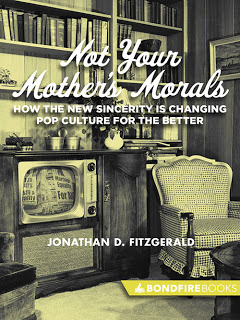
The movie is a perfect example of what Jonathan Fitzgerald writes about in his new book Not Your Mother’s Morals (full disclosure: I received a free review copy from Jon, and it's only 99 cents on Amazon right now!). Fitzgerald, managing editor of PatrolMag.com, Huffington Post blogger, and columnist at Patheos, argues that in pop culture today, “detached irony and cynicism have ceded ground to an emphasis on sincerity and authenticity. The ‘too cool to care’ attitude that typifies Generation X has become ‘cool to care’ for Millennials. This New Sincerity has become the vehicle for a resurgence in moral storytelling in popular culture.”
In the short book, which is part memoir, part cultural analysis, and part graduate-thesis, Fitzgerald writes winsomely about his upbringing in a slightly charismatic evangelical culture, its suspicion of everything on the television, and the alternatives created by “Christian pop culture”. His stories are familiar to any of us who weren’t allowed to watch the Smurfs because of the magic, or who rocked out to Amy Grant, you know, until she went “secular” with “Heart in Motion”.
Putting that critical perspective of pop culture he grew up with to good use, Fitzgerald examines how the moral messages about God, Family, and Country in pop culture have changed over the last sixty years or so. While some evangelical Christians argue that pop culture today is a moral wasteland in comparison to the squeaky-clean offerings of the 1950s, Fitzgerald disagrees. Offering examples from film, tv, music, and books, he shows that a growing emphasis on being sincere has opened up possibilities for honest discussion of morality within our culture, and that that’s a good thing. If sincerity is "in," our sincere Christian faith can't be as easily dismissed.
The kind of morality ushered in by the New Sincerity isn’t a strict code, he argues, but a moral posture, one that acknowledges that what is “right” looks different in different circumstances. Is he arguing in favor of “situational ethics”? my old evangelical self gasps. Yes, of course he is. How can morality exist without a situation? The best stories are the truest ones, and the truest ones show the complexity of our lives, the complexity of our moral decisions. The New Sincerity lets us tell those stories and offer real, moral conclusions without being mocked.
The book is short, and Fitzgerald’s argument needs further fleshing out to be truly compelling. There are plenty of examples from pop culture that don’t fit his cynical/sincere dichotomy, and some of the examples he uses don’t hold up under deeper examination. The tv show Glee, for example, demonstrates the power of sincerity, as he notes; but it also demonstrates the weakness of art turned didactic. In addition, Fitzgerald neglects to address the role that changing media has had in fostering the New Sincerity; Lady GaGa connects to her fans in a way that Madonna didn’t in large part because of new media like Twitter, which demands a level of transparency.
In his conclusion, Fitzgerald contends that the New Sincerity is something to embrace, because it offers the best kind of place to dialogue about faith. Let’s try, he urges, to “stave off” the (inevitable?) descent back into cynicism.
Maybe I appreciate Fitzgerald's book, and the film "Safety Not Guaranteed," so much because when I was leaving Seattle, almost three years ago, I wrote that it was time in my life “to move out of cynicism and towards sincerity”. Growing in my faith has meant embracing the discipline of earnestness. For those of us who identify with Generation X, sincerity can be a difficult posture in which to reside, but I think I'm with Fitzgerald here. Let's do something that requires sincerity, and the possibility of failure: let's try, and while we may not manage to build a time machine, maybe we'll find that something a little magical - some deeper, truer, human connections - can exist.
Tuesday, January 8, 2013
a few things in January
The Stages by Thom Satterlee - Thom is a friend, poet and writer in residence at Taylor, and fellow member of Gethsemane Episcopal. It's always nerve-wracking to begin a book written by someone you know, because what if it's awful. This book, though, was truly excellent. Here's the review I left at goodreads: "An intelligently written literary mystery, The Stages tells the story of Dan Peters, an American translator (and Aspie) living in Copenhagen. When his colleague and best friend dies mysteriously and a Kierkegaard manuscript goes missing, Peters seeks to clear his own name in the murder investigation.
With a strong setting, well-developed characters, surprising plot twists, and a solid grounding in philosophy, theology, and language, this book is heads and shoulders above most murder mysteries. Highly recommended. (Currently only available on kindle- and a steal at 2.99!)"
Torn by Justin Lee I basically want to recommend this to every Christian I know. Whether or not I agree with every conclusion Lee comes to, his poignant, vulnerable story is one that Christians - especially those who have never had a gay friend - need to hear. This book is not primarily an argument for gay rights or gay marriage, although Lee does take a little time to explain how his mind changed on those topics. It is primarily a story, one that you need to read with an open heart, ready to learn from it without simply jumping to find things you agree or disagree with.
Not Your Mother’s Morals by Jonathan Fitzgerald ebook available here - full review coming soon.
A Girl of the Limberlost by Gene Stratton Porter I read this because it's free on Kindle, and because I rememberd my mom recommending it to me like 10 years ago. I absolutely loved it. Set in Indiana (!) in the early 1900s, it's a beautiful coming of age story that demonstrates so many American cultural values - self-reliance, pulling yourself up by your own bootstraps, the value of hard work and education. It also has a unique naturalist perspective, and it made me think a lot about humanity, the natural world, and technology.
As for movies, we really liked Safety Not Guaranteed. Josh Radnor's newest offering, Liberal Arts, was ok, a bit predictable, and really! he's playing the same Ted Mosby role again and again! Jack and I both sobbed through Les Miserables in the theater (and it totally changed his mind about Anne Hathaway - from contempt to admiration), and on Amazon Prime we're watching Foyle's War, which his parents recommended. It's a classic British detective show set in the south coast of England during World War II.
Tuesday, October 23, 2012
psalms for children and the heavy hearted
I didn’t really have a problem with God until I hit my 20s. Up to then, he had been — like my human father — good, kind, and sometimes inscrutable, but always loving, always approachable, always there.
It wasn’t that I had never questioned him — to be fair, in my teens I had battled doubts about God, but they had been cerebral, intellectual doubts. I read the existentialists, and I studied world religions, and I wondered if all that I understood from the Bible could possibly be true.
But emotional doubts — those I had never encountered. I had never railed against God for his absence and silence; in my sweet, safe, sheltered life I had never had cause to question his goodness. As far as I knew, no one else had either.
So when my world flipped upside down at the age of 23, when God absconded, I lacked the emotional vocabulary I needed to pray through it.
{Read the rest at The Living Church.}
{I promise, I do write things other than book reviews, sometimes.}
Thursday, July 5, 2012
ten beautiful modern novels
Young Adult fiction might be my favorite. For escape I like to read YA fiction, mysteries, memoir, novels, and occasionally fantasy. I love the classics, too. Julius Caesar, Pride and Prejudice, The Great Gatsby, The Sound and the Fury, Notes from Underground, Things Fall Apart. I love poetry: Rilke, John Donne, George Herbert, T.S. Eliot, Emily Dickinson, Billy Collins, Sara Teasdale, W.S. Merwin, Mary Oliver.
But to get to the point: if I had to choose, now, I'd probably choose the modern (20th century) American novel. (I just wouldn't be able to decide if I wanted to do the 1920s, the 1950s, or the 1990s.)
Here are ten great American novels. For this list I went with very recent books, all from the 20th and 21st centuries:
Wednesday, July 4, 2012
ten loved memoirs
Memoir is one of my favorite genres, and I have an especial weakness for spiritual memoir and foodie memoirs. Here are ten memoir-ish books that I've loved.
And there are so many more...what are yours?
Tuesday, July 3, 2012
ten nonfiction books that shaped my faith
(1997-2003)
1. The Return of the Prodigal Son by Henri Nouwen. My youth pastor preached a series on a weekend retreat based on this book, and I later read the book itself. The messages were some of the most powerful I had ever heard, about God's love, about art and faith, and about myself as the older brother.
Monday, July 2, 2012
ten books that shaped me in childhood
I'm going to try to chime in every day this week. Today I'm going to highlight one book, and then list (in no particular order) the others.

I'm starting with my favorite place to start:
What's your favorite book from childhood?
Friday, June 22, 2012
a few things in June
Borgen. Look. There's no Josh Lyman (yeah, I loved Josh - who didn't?), and the dialogue isn't quite as fast and funny as Aaron Sorkin-style writing, but if you liked The West Wing, you will have to like Borgen, a Danish drama about the first female Prime Minister in Denmark - her cabinet, her family, and the government's relationship to the media. I don't want to give anything away, but if you were interested in Anne-Marie Slaughter's article at Atlantic Monthly this week questioning what it means for women to "have it all," you will love watching Borgen's answer as Prime Minister Birgitte Nyborg wrestles with her work/family balance. And, as a student of intercultural studies, I also have to say that it's fascinating to observe this small, wealthy, post-Christian European country through its own eyes.
Rain for Roots. We've been listening to these folk songs for little ones quite a bit over the last month. With lyrics by Sally Lloyd Jones and music by Sandra McCracken, Ellie Holcomb, Flo Paris, and Katy Bowser, they satisfy me both in terms of musical quality and content -- and Rosie LOVES them. My favorite thing about them is that each song points to God. A lot of Christian resources for kids tend to be moralistic, focusing on encouraging good behaviors - be patient, share, don't complain, obey.
And, sure, kids need to be taught these things. But in training our children, it's all too easy to subtly teach them to rely on her own ability to be good and acceptable to God, rather than to rely on God himself.
Sometimes kids just need to be pointed to God. So instead of hearing, "Daniel was brave and obeyed God - you should be brave and obey, too!" I like that Rosie gets to hear
Who heard Daniel when he prayed?
Who helped him not be afraid?
Who stayed beside him in that den?
Who brought him safely out again?
It’s God who kept him in his care.
He’ll keep you, too--no matter where!
Precious Remedies Against Satan's Devices
This latest album from The Welcome Wagon is beautiful. My sister sent it to me for my birthday, and she reviewed it here.
A Good and Perfect Gift: Faith, Expectations, and a Little Girl Named Penny
Amy Julia Becker, a graduate of Princeton and Princeton Seminary, writes in this book about becoming a mother to her first child, Penny, who has Down Syndrome. I am almost finished with the book, and I appreciate her candor and care in sharing her story. (The kindle version of the book is only $2.99 for the month of June!)
Overdressed: The Shockingly High Cost of Cheap Fashion
I'm about a third of the way through this book, which details the history of the garment-making industry in America and shows how "cheap fashion" has changed the way Americans dress and turned clothing into a disposable good. So far it's dry at some points and fascinating at others, and I've got a lot of thoughts developing about how to think Christianly - redemptively - about the fashion industry. I'm sure I'll write more about this soon. (For now, how about this example of redeeming disposable clothing?) (Full disclosure: I received this book free from the publisher.)
On the blog front, this month I've become a huge fan of D.L. Mayfield's writing, and I love the stories Jessica Goudeau shares at Love Is What You Do. Both of these women work with refugees, and some (though not all) of their writing relates to that. Incidentally, this month I've been volunteer-teaching a group of Burmese refugees at a sewing factory in Gas City. It's worlds different than what I usually do, teaching wealthy Korean college students, and it's a challenge. I am stunned by the histories of these Burmese people, and by their resilience and work ethic and hope.
And, frankly, I can't wait to see Brave.
Wednesday, March 7, 2012
The Princess and the Three Knights: a book review
I promised a full review of Karen Kingsbury's picture books, and (this time, at least), I'm keeping my word.
"I have nothing against princesses, when they are done right. But I do tend to get up in arms when the story told - especially by Christians - to my daughter features a beautiful, silent, passive, nameless teenage princess who needs only a man chosen for her to marry in order to have a happy ending.
Stories matter, and in this formative period in which my daughter can remember the words to a book after hearing it only once or twice, I'm careful about what she hears, especially if she's hearing about God. That's why I find The Princess and the Three Knights (Zonderkids 2009), by Christian romance novelist Karen Kingsbury, so troubling."
Hop over to the Christianity Today Women's Blog, Hermeneutics, to read the whole thing, and chime in with your own experiences or critiques there.
Monday, February 20, 2012
a princess problem, part one
This morning I was a scientist studying lions and a magic doctor healing giraffes. I was a three year old girl holding a baby jaguar; I was a "halt-man" (which is exactly what it sounds like); and I was a pony running through a candy forest. I was friends with a lion, a little girl, another pony, and finally, a princess.
She put on an ancient nightgown. "I think this twirls," she said, experimenting. "I must be a princess!"
Time to engage in some research. "What do princesses do?" I asked.
"I don't know," she said. "They organize things."
Then,
"Sometimes," she continued, "people think I'm a princess."
"Why do they think that?" I asked.
"Because they think I'm pretty," she said nonchalantly, and then with passion, "Chase me!" And we're back to tag, running in circles around the house, the all-time favorite activity.
I have nothing against twirly skirts, telling our daughters that they are beautiful, or fairy tales with happy endings. I like love stories, including my own, which, incidentally, began a long time ago in a faraway land and involves a strong man with kind eyes.
I have nothing against princesses, when they are done right. And I think even Disney does them right, sometimes.
But I get all up in arms when the role model suggested - by Christians - for my three year old daughter is a beautiful, silent, passive, nameless, objectified teenage princess who only needs a man chosen for her to marry in order to have a happy ending.
Oh, this book gets my heart rate up. I've tried to ignore it for a year now, but it keeps showing up. And I looked at reviews online and they're all positive! So I am compelled. I'll tell you more about this book (and its counterpoint for boys), and why I - not to mince words - hate it, in a few days, when I calm down. Or even if I don't.